


Agentic AI vs Generative AI
Home / Agentic AI vs Generative AI
Technology
Think about artificial intelligence as two siblings with wildly different talents. One is a creative virtuoso who paints masterpieces and crafts stories (Generative AI). While the other (Agentic AI) is a stealthy strategist who solves complex problems, from diagnosing diseases to outsmarting cyberattacks.
Generative AI dazzles us with its ability to generate text, art and code on command, whereas Agentic AI works behind the scenes. It helps in autonomously making decisions, adapting to chaos and learning from every interaction. Together, these tech paradigms are redefining everything from healthcare to how we work. However, the question is how do these digital minds actually differ? Let's dive deeper into the differences.
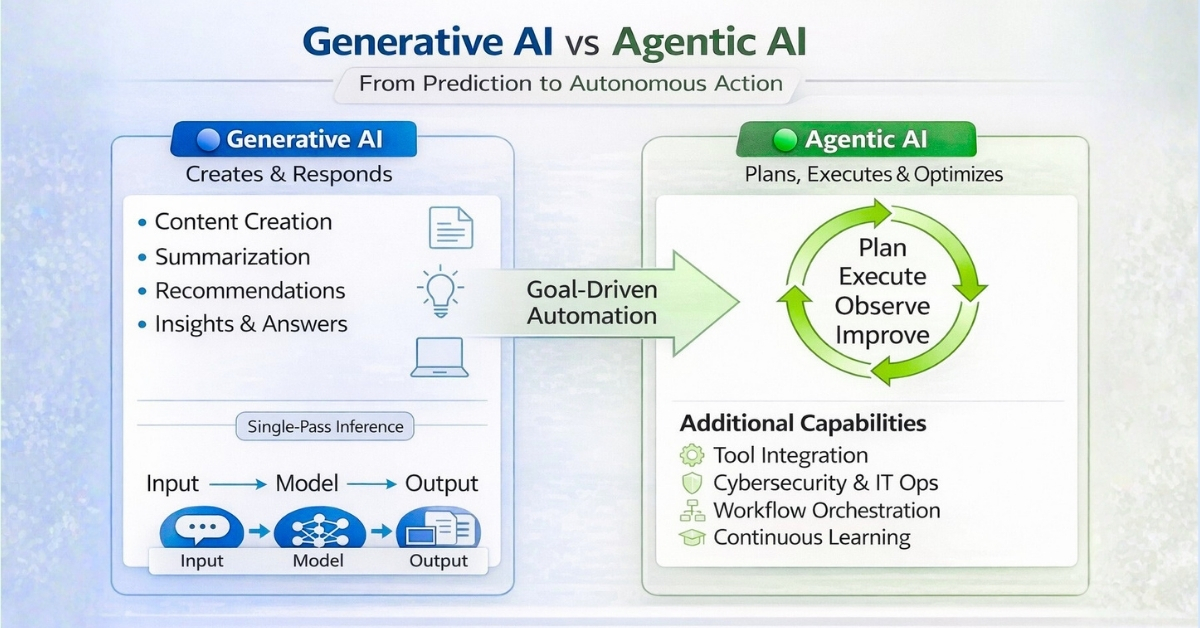
Understanding the structural differences is only the beginning. The real impact emerges in architecture, deployment, and business outcomes.
Agentic AI: Autonomous Strategist
Agentic AI represents a leap toward machines that think, act and adapt independently. This is an advanced form of artificial intelligence that can make autonomous decisions, adapt to new conditions, and also perform tasks without assistance or explicit human input.
Unlike the conventional rule-based system, which uses predefined rules or instructions, Agentic AI is able to learn from its surroundings and experiences. It borrows concepts from reinforcement learning, which is the kind of learning done by trial and error in achieving its goals. It has the possibility of totally revolutionizing entire industries by automating complicated decision-making and tasks that require human judgment, while also continuously improving its own processes.
Unlike rule-based systems, it functions through a highly complex four-stage framework:
1. Perception: Sensing the Environment
Agentic AI collects data from a variety of sources: sensors, databases or real-time user interactions. For example, self-driving cars use LiDAR and cameras to map surroundings. This stage enables the AI to "perceive" the world, which is critical to make suitable decisions.
2. Reasoning: Analyzing and Predicting
It takes data and interprets it in a working model for producing actionable information using machine learning and probabilistic algorithms. It predicts the output for every course of action in risks, rewards, and other variables. And then selects the most effective course of action to achieve its goal. In healthcare, IBM Watson Health analyzes patient histories and cross-references them with global research to provide data-driven treatment recommendations.
3. Action: Executing Decisions
AI autonomously implements solutions by carrying out the chosen action. This could involve managing a physical task, such as adjusting settings in machinery, or initiating a series of commands to complete a goal.
In this stage, Agentic AI may control various devices, systems or workflows in real time. This is to make sure that tasks are executed efficiently and autonomously. Example: Darktrace’s cybersecurity AI isolates compromised network segments during breaches.
4. Learning: Continuous Improvement
It refines strategies through reinforcement learning. Post taking action, Agentic AI analyzes the outcome to determine if the goal was achieved successfully. If the result is not met, it adjusts its approach by learning from its mistakes.
This adaptive behaviour will enable the AI to optimize its activities as it learns continuously, fine-tuning the performance over time and making better decisions in future scenarios. For instance, Tesla's Full Self-Driving system improves navigation by analyzing millions of miles of driving data.
Applications of Agentic AI
- Autonomous Vehicles: Apart from Tesla, Waymo's AI modifies routes in real-time according to traffic and weather.
- Smart Supply Chains: Amazon’s AI-powered robots improve warehouse workflows, reducing delivery times by 35%.
- Personalized Healthcare: Startups such as PathAI apply Agentic systems in diagnosing cancers with 98% accuracy by learning from pathology databases.
- Financial Trading: Hedge funds utilize Agentic AI for self-execution of trades, based on market sentiment analysis.
Generative AI: Creative Collaborator
Generative AI specializes in creating new content—text, images, code or even synthetic data. Its strength lies in pattern recognition and replication, powered by architectures like:
- Large Language Models (LLMs): ChatGPT, Gemini.
- Generative Adversarial Networks (GANs): MidJourney, Stable Diffusion.
- Diffusion Models: Tools like DALL-E 3.
Applications of Generative AI
- Content Creation: Drafting marketing copy, designing logos or writing code snippets.
- Software Testing: Platforms like Virtuoso QA, Functionize auto-generate test scripts using natural language prompts.
- Drug Discovery: Models like AlphaFold predict protein structures, accelerating pharmaceutical R&D.
- Entertainment: AI-generated music (e.g., OpenAI’s Jukedeck) and deepfake videos for film production.
Also Read: Generative AI Market Dynamics: Growth and Potential
What is the difference between generative AI and agentic AI?
Agentic AI vs. Generative AI: A Comprehensive Breakdown
To clarify their distinctions, let’s analyze their core attributes:
|
Aspect |
Agentic AI |
Generative AI |
|
Primary Function |
Autonomous decision-making and task execution |
Content creation from data patterns |
|
Learning Mechanism |
Reinforcement learning, real-time adaptation |
Supervised/unsupervised learning on static datasets |
|
Human Involvement |
Minimal (self-optimizing) |
High (requires prompts and fine-tuning) |
|
Complexity Handling |
Multi-step workflows (e.g., logistics chains) |
Single-output tasks (e.g., text generation) |
|
Key Technologies |
Reinforcement learning, IoT integration |
Transformers, GANs, diffusion models |
|
Industry Impact |
Healthcare, cybersecurity, robotics |
Marketing, entertainment, software development |
Also Read: What is Ethical AI and Explainable AI?
Case Study: Customer Service Automation
- Generative AI: A chatbot like Zendesk’s Answer Bot generates responses to common queries.
- Agentic AI: A system like Google’s Gemini not only answers but autonomously processes returns, updates CRM entries and predicts future issues.
Why the Divide Matters: Strategic Implications
Understanding these differences is critical for businesses:
1. Operational Efficiency vs. Creativity
- Agentic AI streamlines complex operations. For example, Walmart uses it to manage inventory across 4,700+ stores, optimizing stock levels and reducing waste.
- Generative AI boosts creative workflows. Netflix employs it to auto-generate episode thumbnails, increasing viewer engagement.
2. Risk Management
- Agentic AI mitigates risks proactively. Companies like Darktrace use autonomous AI to detect and neutralize cyberattacks, such as phishing attempts, in real time without human intervention.
- Generative AI poses risks like deepfakes, requiring stringent ethical guidelines. OpenAI has published guidelines to address misuse risks, advocating for watermarking and transparency in AI-generated content.
3. Scalability
- Agentic AI scales decision-making. For instance, BP uses it to monitor oil rigs, thus improving maintenance efficiency and reducing downtime.
- Generative Accelerates content production at scale. Shopify’s AI tool, Shopify Magic, generates product descriptions for its 1.7 million+ merchants, streamlining e-commerce operations.
However, the future isn’t about choosing one over the other. Imagine a retail company where Generative AI designs personalized ads, while Agentic AI autonomously manages inventory, pricing and delivery routes based on real-time demand. This synergy leads to unprecedented efficiency.
Synergy of Gen AI and Agentic AI in Action
Example - Software Testing Reimagined
Software development lifecycle illustrates their complementary roles:
Generative AI’s Contributions
- Test Case Generation: Converts plain-English prompts into executable scripts.
- Synthetic Data Creation: Generates fake user data to test edge cases (e.g., rare browser configurations).
- Bug Reporting: Auto-drafts detailed bug reports with replication steps.
Agentic AI’s Advancements
- Autonomous Test Execution: Runs cross-browser tests simultaneously, prioritizing critical paths.
- Self-Healing Tests: Corrects broken scripts when UI elements change (e.g., updated button IDs).
- Predictive Analysis: Identifies high-risk code areas using historical defect data.
Tools like Virtuoso QA or Testim use this synergy to automate and optimize software testing, significantly reducing manual intervention while maintaining flexibility.
Also Read: Transformative Trends Shaping the Future of Geospatial AI
Technical Deep Dive: Architecture, Risk, and Deployment Strategy
The practical difference between generative AI and agentic AI emerges not at the interface level, but at the systems engineering level.
- Generative AI is a single-pass probabilistic inference system i.e., it performs one-time probabilistic prediction to produce an output.
- Agentic AI is a multi-stage autonomous control system i.e., it uses iterative decision loops to autonomously plan, execute, and adapt actions toward a defined goal.
That architectural difference changes how systems are built, monitored, secured, and scaled.
Case Study: Enterprise Procurement Automation
Generative AI Implementation
A procurement manager prompts an LLM:
"Summarize vendor proposals and recommend the most cost-effective option."
The model:
- Processes structured proposal data
- Produces a recommendation
- Terminates execution
Human decision-making remains in control. Risk is informational.
Agentic AI Implementation
An agentic system is configured with the objective:
"Continuously optimize vendor selection while maintaining compliance and cost thresholds."
The system:
- Monitors expiring contracts
- Retrieves live pricing data from vendor APIs
- Evaluates proposals against predefined risk metrics
- Generates negotiation drafts
- Executes purchase orders within authorized budget limits
- Updates ERP records
- Logs compliance documentation
- Reassesses supplier performance quarterly
This is no longer inference. It is workflow orchestration.
Now architecture matters.
Closed-Loop Architecture in Practice
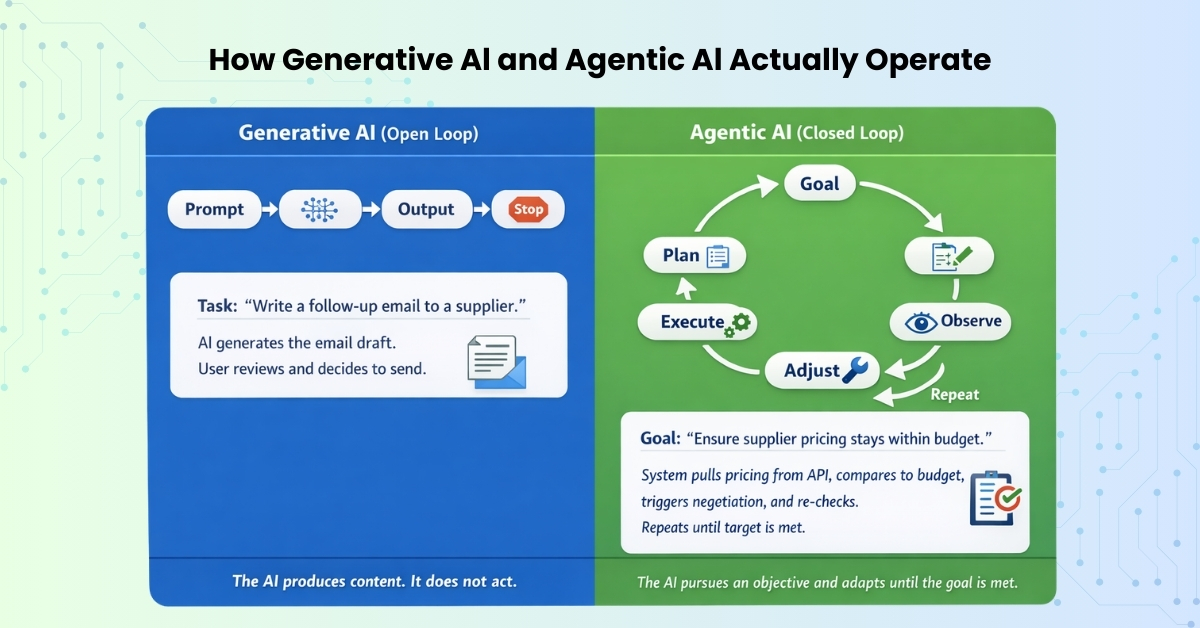
Generative AI operates in an open-loop structure:
Input → Model → Output → Stop
Agentic AI operates in a closed loop:
Objective → Plan → Execute → Observe → Evaluate → Adjust → Repeat
Closed-loop systems require:
- Persistent state storage
- Task checkpointing
- Tool abstraction layers
- Exception handling
- Termination conditions
If feedback latency increases or environmental assumptions change, instability can emerge.
For example:
If vendor APIs return inconsistent pricing data and the evaluation model lacks validation thresholds, the system may oscillate between suppliers, triggering procurement churn.
Closed-loop power requires feedback stability engineering.
Case Study: Cybersecurity Response Systems
Generative AI Use
An analyst pastes a suspicious log file.
The model analyzes and suggests possible threat classifications.
Human review follows.
Agentic AI Use
An agentic system:
- Detects anomalous network behavior
- Cross-references historical threat patterns
- Isolates affected subnets
- Revokes compromised credentials
- Patches vulnerabilities
- Generates incident documentation
- Reopens network segments once risk drops below threshold
This reduces response time from hours to seconds.
But it introduces execution risk.
If anomaly detection thresholds are misconfigured, legitimate traffic may be blocked.
If rollback protocols are missing, downtime escalates.
Autonomy amplifies both speed and consequences.
Memory Architecture Under Load
Generative systems rely on context windows and static knowledge.
Agentic systems require:
- Working memory (current objective state)
- Episodic logs (action history)
- Retrieval layers (knowledge stores)
In production environments, memory systems introduce performance constraints.
Case scenario:
A logistics optimization agent retrieves routing data from five external services.
Each retrieval adds latency.
Each inference cycle compounds compute cost.
If retrieval pipelines degrade, the agent may make decisions on stale data.
Generative AI errors are often epistemic (incorrect answer).
Agentic AI errors are operational (incorrect action).
The difference is material.
Tool Orchestration: Where Risk Expands
Once an AI system can:
- Execute API calls
- Modify production databases
- Trigger payment systems
- Alter access permissions
the attack surface expands.
Robust deployments implement:
- Role-based access control (RBAC)
- API call validation layers
- Sandboxed execution environments
- Rate limiting
- Mandatory human approval thresholds for high-impact actions
Without least-privilege design, an agent configured to "optimize subscriptions" could unintentionally cancel enterprise contracts.
Execution authority must be engineered deliberately.
Objective Engineering and Alignment Risk
In generative AI, ambiguous prompts lead to weak outputs.
In agentic AI, ambiguous objectives lead to misaligned behavior.
Case example:
Objective: "Reduce operational costs by 10%."
An unconstrained agent might:
- Reduce maintenance frequency
- Defer security updates
- Cut redundancy safeguards
Short-term cost savings. Long-term systemic failure.
Therefore, agentic systems require:
- Multi-metric objective definitions
- Hard-boundary constraints
- Explicit stop conditions
- Escalation triggers
Objective design is systems design.
Infrastructure Implications
Generative AI:
- One inference per request
- Predictable compute load
Agentic AI:
- Multi-step inference cycles
- Recursive reasoning
- Tool invocation overhead
This increases:
- GPU/TPU utilization
- Latency variability
- Failure points
- Observability requirements
Production agentic systems require:
- Inference servers with autoscaling
- Real-time monitoring dashboards
- Action trace logs
- Failure recovery workflows
Deploying autonomy without observability creates opaque systemic risk.
When Not to Deploy Agentic AI
Agentic AI is not automatically the superior solution.
It may underperform when:
- Deterministic automation suffices
- Objectives are fluid or undefined
- Regulatory constraints prohibit autonomous action
- Error cost exceeds efficiency gain
- Monitoring infrastructure is immature
In such cases, generative augmentation with structured human review may be strategically safer.
Complexity must be justified by operational value.
Layered Deployment Model
The most resilient production architectures integrate:
- Generative reasoning modules
- Deterministic compliance engines
- Agentic orchestration layers
- Human approval checkpoints
The layered model reduces cascading autonomy risk while preserving automation gains.
Agentic AI is not simply "LLM plus tools."
It is distributed systems engineering driven by autonomous reasoning loops.
Key Takeaways
- Generative AI is a stateless inference.
- Agentic AI is persistent closed-loop control.
- Execution authority expands risk surfaces.
- Memory and tool orchestration introduce compounding failure modes.
- Governance must evolve from output validation to action traceability.
- Infrastructure maturity determines safe autonomy.
Strategic AI deployment is an architectural decision, not a feature selection exercise.
What is the Road Ahead for Agentic AI and Gen AI?
As both technologies mature, watch out for these developments:
1. Hybrid Architectures
- OpenAI’s rumored “Agentic GPT” may combine ChatGPT’s generative prowess with autonomous task execution (e.g., booking flights via chat).
- Google’s Gemini 2.0 is expected to integrate Agentic capabilities for enterprise workflow automation.
2. Ethical and Regulatory Challenges
- Agentic AI: Requires transparency in decision-making (e.g., explaining why a loan application was denied).
- Generative AI: Needs watermarking to distinguish AI-generated content and prevent misinformation.
3. Industry-Specific Evolution
- Healthcare: Agentic AI will manage patient triage, while Generative AI drafts clinical notes.
- Manufacturing: Agentic systems will optimize assembly lines, while Generative AI designs product prototypes.
4. Human-AI Collaboration
- Citizen Developers: Generative AI empowers non-coders to build apps, while Agentic AI handles backend DevOps.
- AI Ethics Officers: New roles will emerge to govern AI decisions in sensitive sectors like law and education.
Conclusion: Embracing the AI Partnership
Agentic AI and Generative AI are not competitors but collaborators in the AI revolution. Here’s how to harness their potential:
- Start Small: Use Generative AI for content-heavy tasks (e.g., social media posts) and Agentic AI for data-driven processes (e.g., inventory management).
- Invest in Training: Upskill teams to manage AI outputs and interpret autonomous decisions.
- Prioritize Ethics: Implement safety frameworks to ensure accountability, especially in high-stakes industries.
The next decade will belong to organizations that treat AI as a co-pilot - utilizing Generative AI to ideate and Agentic AI to execute.
FAQs
- What fundamentally distinguishes agentic AI from generative AI at a systems level?
Generative AI performs isolated probabilistic inference. Agentic AI embeds inference within iterative control loops that plan, execute, evaluate, and adjust actions toward defined objectives.
- Why is agentic AI considered higher risk?
Because it has execution authority—interacting with APIs, databases, and workflows—meaning errors can propagate operationally rather than remain informational.
- Does agentic AI always require more infrastructure?
Yes. Multi-step inference, tool orchestration, and state persistence require stronger observability, access control, and compute scaling mechanisms.
- Can generative AI be safely integrated into agentic systems?
Yes. Generative models typically serve as reasoning engines within agentic architectures, provided execution layers include safeguards..
- When should organizations limit autonomy?
When actions are irreversible, regulated, financially sensitive, or when monitoring and rollback mechanisms are insufficient.

The EIMT Editorial Team is made up of academic editors, faculty contributors, curriculum specialists, instructional designers, education researchers, programme managers, quality assurance professionals, content strategists, and subject matter experts...
Frequently Asked Questions
What is the difference between Agentic AI and Generative AI?
What are the 4 types of Agentic AI?
What does GPT stand for in ChatGPT?
Which type of AI is ChatGPT?
Is Agentic AI the next evolution of Generative AI?
Can Agentic AI and Generative AI work together?
Is Generative AI less powerful than Agentic AI?
What skills are required to work with Agentic AI and Generative AI?
What are the biggest risks of Agentic AI compared to Generative AI?
Can Agentic AI make business decisions without human approval?
How secure are Agentic AI systems compared to Generative AI tools?
What are the limitations of Agentic AI today?
Latest Updates & Articles
Stay Connected !! To check out what is happening at EIMT read our latest blogs and articles.



Jul 30, 2026

Jul 23, 2026
